There are two different approaches to building quantum networks - a land-based network and a space-based network.
Both methods work well for sending regular bits of data across the internet today, but if we want to send data as qubits in the future, it is much more complicated.
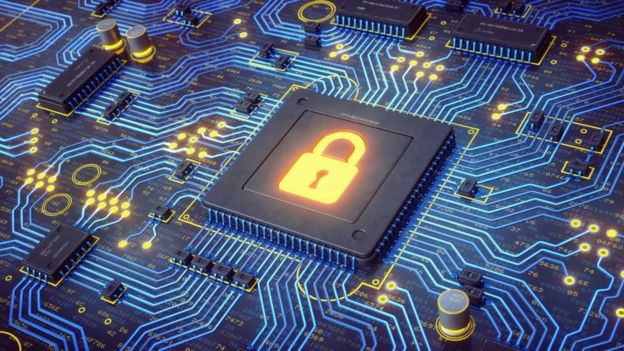
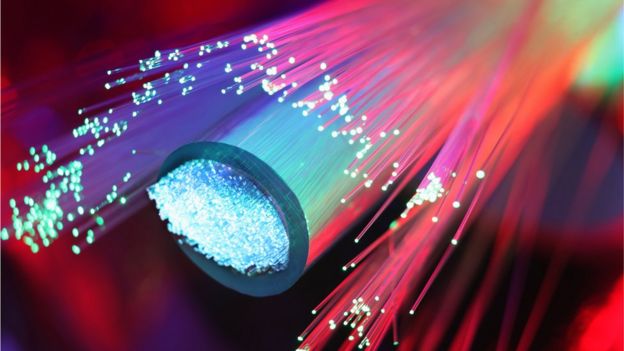
To send particles of light (photons), we can use fibre optic cables in the ground. However, the light signal deteriorates over long distances (a phenomenon known as "decoherence"), because fibre optics cables sometimes absorb photons.
It is possible to get around this by building "repeater stations" every 50km. These would essentially be miniature quantum laboratories that would try to repair the signal before sending it on to the next node in the network. But this system would come with its own complexities.
Land or space?
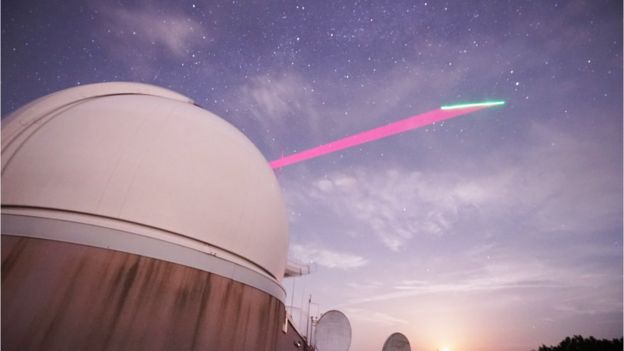
Then there are space-based networks. Let's say you want to send a message from the UK to a friend in Australia. The light signal is beamed up from a ground station in the UK, to a satellite with a light source mounted on it.
The satellite sends the light signal to another satellite, which then beams the signal down to a ground station in Australia, and then the message can be transmitted over a ground-based quantum network or classical internet network to the other party.
"Because there's no air between the satellites, there's nothing to degrade the signal," says Dr Jamie Vicary, a senior research fellow at Oxford University's department of computer science and a member of the Networked Quantum Information Technologies Hub (NQIT).
"If we want to have a really global-scale quantum internet, it looks like a space-based solution is the only way that will work, but it's the most expensive."
Quantum teleportation via space has been conducted successfully, and scientists are currently vying to demonstrate longer and longer distances.
Scientists from the Chinese Academy of Sciences generated headlines in June when they succeeded in teleporting entangled photons between two towns in China located 1,200km apart. They used a specially developed quantum satellite called Micius.
The same Chinese scientists recently topped their own record on 29 September, by demonstrating the world's first intercontinental video call protected by a quantum key with researchers at the Austrian Academy of Sciences - over a distance of 7,700km.
The call lasted for 20 minutes and the parties were able to exchange encrypted pictures of the Micius satellite and Austrian physicist Erwin Schrödinger.
Rupert Ursin, senior group leader at the Austrian Academy of Sciences' Institute for Quantum Optics and Quantum Information believes the quantum internet will need land-based and space-based networks to operate in parallel.
"In the cities, we need a fibre network, but long haul connections will be covered by satellite links," he explains.
How does quantum key distribution work?

To understand how QKD works, let's go back to the video call made between the Austrian and Chinese scientists. The Micius satellite used its light source to establish optical links with the ground stations in Austria and the ground stations in China.
It was then able to generate a quantum key.
The great thing about quantum encryption is you can detect whether someone has tried to intercept the message before it got to you, and how many people tried to access it.
Micius was able to tell that the encryption was secure and no one was eavesdropping on the video call. It then gave the go ahead to encrypt the data using the secret key and transmit it over a public internet channel.
Routing messages
Multiple groups of scientists are developing land-based networks by working on the technologies for quantum repeater stations, which are located every 50km, connected by fibre optic cables.
These repeater stations, also known as "quantum network nodes", will need to perform several actions in order to route, or direct, messages around the network.
First, each node needs to repair and boost the signal that was damaged from the previous 50km stretch of the network.
Imagine that you're using an old fax machine to send a one-page document to someone else, and each time you send the page, a different part of the message is missing, and the other party has to piece the message together from all the failed attempts.
This is similar to how a single message may have to be sent between different nodes on a quantum network.
There will be many people on the network, all trying to talk to each other. So the node, or repeater station, will also have to figure out how to distribute its available computing power in order to piece together all the messages being sent. It will also have to send messages between the quantum internet and the classical internet.
The University of Delft is building a quantum network using nitrogen vacancies in diamonds, and it has so far shown the ability to store and distribute the links needed for quantum communications over quite large distances.
The University of Oxford and the University of Maryland are both currently building quantum computers that work in a similar way to a network. Their quantum computers consist of trapped ion nodes that have been networked together to talk to each other.
The bigger the computer you want, the more nodes you have to add, but this type of quantum computer only transmits data over a short distance.
"We want to make them small so they can be well-protected from decoherence, but if they're small then they can't hold many qubits," says Dr Vicary.
"If we connect the nodes up in a network, then we can still have a quantum computer without being limited by the number of qubits, while still protecting the nodes."
Quantum memory
The repeater station will also need to have a quantum memory chip. The nodes create "links", which consist of entangled pairs of light particles. These entangled pairs are prepared in advance.
While the node calculates the route across the network that the message will need to take, it needs to store the entangled pair of photons somewhere safe, so a quantum memory chip is needed. It has to be able to store the photons for as long as possible.
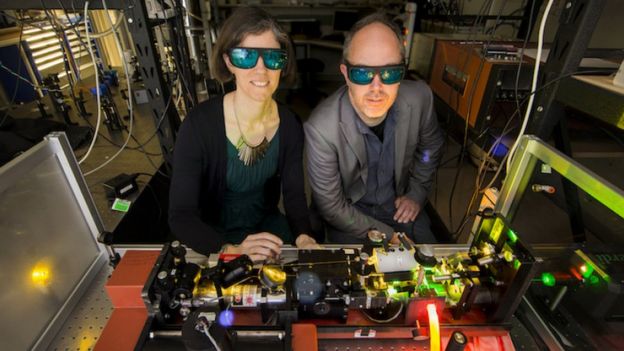
Researchers from the Australian National University (ANU) have developed a telecom-compatible quantum memory chip using an erbium-doped crystal. This device is able to store light in the right colour and it is able to do so for longer than one second, which is 10,000 times longer than all other attempts so far.
"The biggest challenge is now to demonstrate a quantum memory with a large data storage capacity," associate professor Matthew Sellars, program manager in the Centre for Quantum Computation and Communication Technology (CQC2T) at ANU tells the BBC.
"It will be the memory's storage capacity that will limit the data transmission rate through the network.
"I think it will take about five years before the technology [for the quantum internet] is practical."
0 Response to "How do you build the next-generation internet? 2"
Posting Komentar